
Toyota Venza: Torque Sensor Circuit Malfunction (C1511-C1514,C1517)
DESCRIPTION
The torque sensor converts the rotation torque input to the steering wheel into an electrical signal and sends it to the power steering ECU. Based on this signal, the ECU detects steering effort.
|
DTC No. |
DTC Detection Condition |
Trouble Area |
|---|---|---|
|
C1511 |
Torque sensor (TRQ1) signal error or stop |
|
|
C1512 |
Torque sensor (TRQ2) signal error or stop |
|
|
C1513 |
Deviation between torque sensors TRQ1 and TRQ2 exceeds specified value |
|
|
C1514 |
Torque sensor power source voltage error |
|
|
C1517 |
Temporary control due to malfunction related to torque sensor continues for long time |
WIRING DIAGRAM
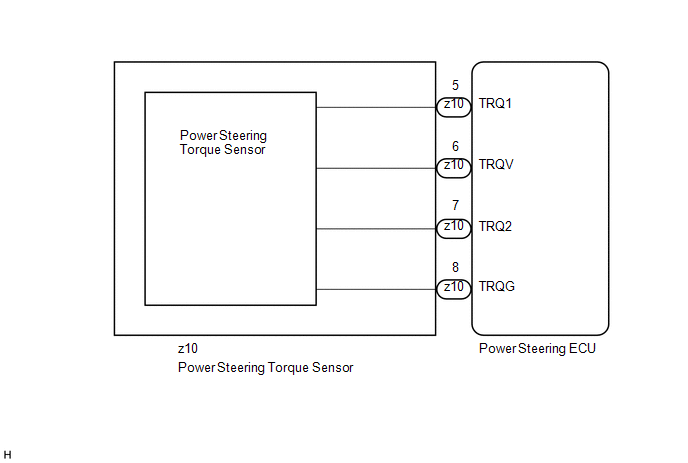
CAUTION / NOTICE / HINT
NOTICE:
If the power steering ECU and steering column assembly have been replaced, perform
the rotation angle sensor initialization and torque sensor zero point calibration
(See page .gif) ).
).
PROCEDURE
|
1. |
CHECK CONNECTOR CONNECTION CONDITION (TORQUE SENSOR - ECU) |
(a) Check the installation condition of the torque sensor connector.
OK:
Torque sensor connector is securely connected to the power steering ECU.
| NG | .gif) |
CONNECT CONNECTOR |
|
.gif)
|
2. |
CHECK POWER STEERING ECU (TRQV VOLTAGE) |
(a) Turn the ignition switch to ON.
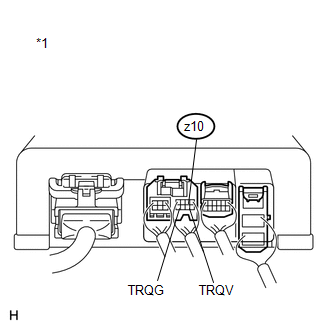
(b) Measure the voltage according to the value(s) in the table below.
Standard Voltage:
|
Tester Connection |
Switch Condition |
Specified Condition |
|---|---|---|
|
z10-6 (TRQV) - z10-8 (TRQG) |
Ignition switch ON |
4.5 to 5.5 V |
|
*1 |
Component with harness connected (Power Steering ECU) |
| NG | |
REPLACE POWER STEERING ECU |
|
|
3. |
CHECK POWER STEERING ECU (TRQ1, TRQ2 VOLTAGE) |
|
(a) Start the engine. |
|
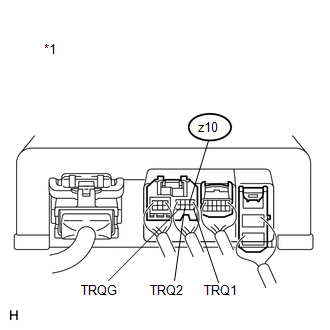
(b) Measure the voltage according to the value(s) in the table below.
Standard Voltage:
|
Tester Connection |
Condition |
Specified Condition |
|---|---|---|
|
z10-5 (TRQ1) - z10-8 (TRQG) |
The engine running, steering wheel not turned (without load). |
2.3 to 2.7 V |
|
The engine running, steering wheel turned to right with vehicle stopped. |
2.5 to 3.8 V |
|
|
The engine running, steering wheel turned to left with vehicle stopped. |
1.2 to 2.5 V |
|
|
z10-7 (TRQ2) - z10-8 (TRQG) |
The engine running, steering wheel not turned (without load). |
2.3 to 2.7 V |
|
The engine running, steering wheel turned to right with vehicle stopped. |
1.2 to 2.5 V |
|
|
The engine running, steering wheel turned to left with vehicle stopped. |
2.5 to 3.8 V |
(c) Under each condition, measure the voltage at terminals TRQ1 and TRQ2, and calculate the sum.
Standard Voltage:
|
Inspection Item |
Condition |
Specified Condition |
|---|---|---|
|
Sum of voltage between z10-5 (TRQ1) and z10-8 (TRQG) and voltage between z10-7 (TRQ2) and z10-8 (TRQG) |
The engine running, steering wheel not turned (without load). |
Between 4.75 V and 5.25 V |
|
The engine running, steering wheel turned to right with vehicle stopped. |
||
|
The engine running, steering wheel turned to left with vehicle stopped. |
|
*1 |
Component with harness connected (Power Steering ECU) |
| OK | |
REPLACE POWER STEERING ECU |
| NG | |
REPLACE STEERING COLUMN ASSEMBLY |
 Motor Circuit Malfunction (C1521,C1531-C1534,C1554)
DESCRIPTION
If the power steering ECU detects these DTCs, it will shut off the motor relay
circuit (built into the power steering ECU) and stop power assist. However, power
assist continues if DT ...
 Torque Sensor Zero Point Adjustment Undone (C1515,C1525)
DESCRIPTION
These DTCs do not indicate a malfunction. The power steering ECU stores these
DTCs when it determines that the rotation angle sensor value initialization and
torque sensor zero point ...
Other materials about Toyota Venza:
Removal
REMOVAL
PROCEDURE
1. DISCONNECT CABLE FROM NEGATIVE BATTERY TERMINAL
NOTICE:
When disconnecting the cable, some systems need to be initialized after the cable
is reconnected (See page ).
2. REMOVE FRONT WHEEL RH
3. REMOVE NO. 1 ENGINE UNDER COVER
4. ...
Inspection
INSPECTION
PROCEDURE
1. INSPECT NO. 1 ULTRASONIC SENSOR
(a) Measure the resistance according to the value(s) in the table below.
Standard Resistance:
Tester Connection
Condition
Specified ...
Checking and replacing fuses
If any of the electrical components do not operate, a fuse may have blown.
If this happens, check and replace the fuses as necessary.
Vehicles with smart key system:
Turn the “ENGINE START STOP” switch off.
Vehicles without smart key system:
Turn th ...

0.1724