
Toyota Venza: Antenna Coil Open / Short (B2784)
DESCRIPTION
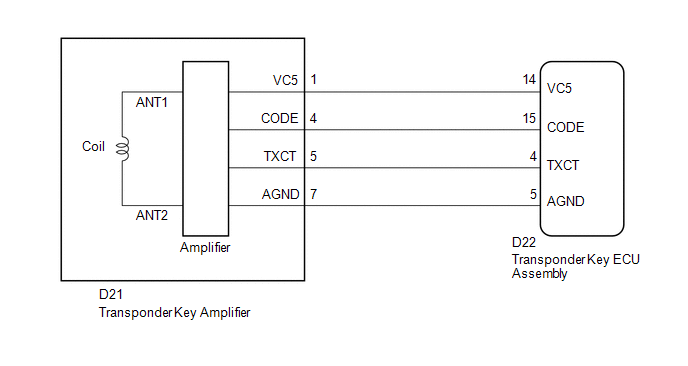
The transponder key coil is built into the transponder key amplifier and receives a key code signal from the transponder chip in the key. This signal is amplified by the amplifier, then it is output to the transponder key ECU assembly.
|
DTC No. |
DTC Detection Condition |
Trouble Area |
|---|---|---|
|
B2784 |
Antenna coil is open/shorted. |
|
WIRING DIAGRAM
CAUTION / NOTICE / HINT
NOTICE:
If the transponder key ECU assembly is replaced, register the key and ECU communication
ID (See page .gif) ).
).
PROCEDURE
|
1. |
READ VALUE USING TECHSTREAM |
(a) Connect the Techstream to the DLC3.
(b) Turn the ignition switch to ON.
(c) Turn the Techstream on.
(d) Enter the following menus: Body Electrical / Immobiliser / Data List.
(e) Read the Data List according to the display on the Techstream.
Immobiliser (Transponder Key ECU Assembly)|
Tester Display |
Measurement Item/Range |
Normal Condition |
Diagnostic Note |
|---|---|---|---|
|
Antenna Coil Status |
Transponder key amplifier coil condition/Normal or Fail |
Normal: Antenna coil normal Fail: Antenna coil malfunctioning |
- |
OK:
On the Techstream screen, the item displays Normal according to the chart above.
| OK | .gif) |
REPLACE TRANSPONDER KEY ECU ASSEMBLY |
|
.gif)
|
2. |
CHECK HARNESS AND CONNECTOR (TRANSPONDER KEY ECU - TRANSPONDER KEY AMPLIFIER) |
(a) Disconnect the transponder key ECU assembly connector.
|
(b) Disconnect the transponder key amplifier connector. |
|
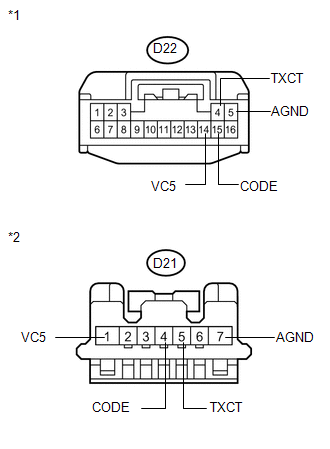
(c) Measure the resistance according to the value(s) in the table below.
Standard Resistance:
|
Tester Connection |
Condition |
Specified Condition |
|---|---|---|
|
D22-4 (TXCT) - D21-5 (TXCT) |
Always |
Below 1 Ω |
|
D22-5 (AGND) - D21-7 (AGND) |
Always |
Below 1 Ω |
|
D22-14 (VC5) - D21-1 (VC5) |
Always |
Below 1 Ω |
|
D22-15 (CODE) - D21-4 (CODE) |
Always |
Below 1 Ω |
|
D22-4 (TXCT) - Body ground |
Always |
10 kΩ or higher |
|
D22-5 (AGND) - Body ground |
Always |
10 kΩ or higher |
|
D22-14 (VC5) - Body ground |
Always |
10 kΩ or higher |
|
D22-15 (CODE) - Body ground |
Always |
10 kΩ or higher |
|
D21-5 (TXCT) - Body ground |
Always |
10 kΩ or higher |
|
D21-7 (AGND) - Body ground |
Always |
10 kΩ or higher |
|
D21-1 (VC5) - Body ground |
Always |
10 kΩ or higher |
|
D21-4 (CODE) - Body ground |
Always |
10 kΩ or higher |
|
*1 |
Front view of wire harness connector (to Transponder Key ECU Assembly) |
|
*2 |
Front view of wire harness connector (to Transponder Key Amplifier) |
| NG | |
REPAIR OR REPLACE HARNESS OR CONNECTOR |
|
|
3. |
INSPECT TRANSPONDER KEY AMPLIFIER (POWER SOURCE AND GROUND) |
(a) Reconnect the transponder key ECU assembly connector.
|
(b) Reconnect the transponder key amplifier connector. |
|
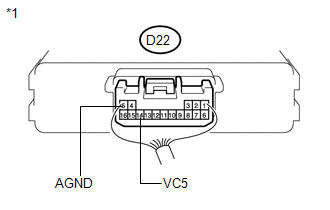
(c) Measure the voltage and resistance according to the value(s) in the table below.
Standard Voltage:
|
Tester Connection |
Condition |
Specified Condition |
|---|---|---|
|
D22-14 (VC5) - Body ground |
No key is in ignition key cylinder |
Below 1 V |
|
D22-14 (VC5) - Body ground |
Key is in ignition key cylinder |
4.6 to 5.4 V |
Standard Resistance:
|
Tester Connection |
Condition |
Specified Condition |
|---|---|---|
|
D22-5 (AGND) - Body ground |
Always |
Below 1 Ω |
|
*1 |
Component with harness connected (Transponder Key ECU Assembly) |
| OK | |
REPLACE TRANSPONDER KEY AMPLIFIER |
| NG | |
REPLACE TRANSPONDER KEY ECU ASSEMBLY |
 Push Switch / Key Unlock Warning Switch Malfunction (B2780)
DESCRIPTION
This DTC is stored if the transponder key ECU assembly does not detect that the
unlock warning switch assembly is ON even when the ignition switch is ON. Under
normal conditions, the ...
 Transponder Chip Malfunction (B2793)
DESCRIPTION
This DTC is stored when a malfunction is found in the key during key code registration
or a key code is not registered normally. Replace the key if the key code registration
is not pe ...
Other materials about Toyota Venza:
Definition Of Terms
DEFINITION OF TERMS
Term
Definition
Monitor description
Description of what the TCM monitors and how it detects malfunctions
(monitoring purpose and its details).
Related DTCs
D ...
Diagnostic Trouble Code Chart
DIAGNOSTIC TROUBLE CODE CHART
HINT:
Parameters listed in the chart may not be exactly the same as your readings due
to the type of instrument or other factors. If a trouble code is displayed during
the DTC check, inspect the trouble areas listed for that ...
Power Back Door cannot be Closed Using the Power Back Door Closer Switch
DESCRIPTION
When the power back door cannot be closed using the power back door closer switch,
either of the following may be malfunctioning: 1) power back door closer switch
circuit or 2) power back door ECU (power back door motor unit).
WIRING DIAGRAM
...

0.2074