
Toyota Venza: If your vehicle has to be stopped in an emergency
Only in an emergency, such as if it becomes impossible to stop the vehicle in the normal way, stop the vehicle using the following procedure:
 Steadily step on the brake pedal
with both feet and firmly depress it.
Do not pump the brake pedal repeatedly as this will increase the effort required to slow the vehicle.
 Shift the shift lever to N.
If the shift lever is shifted to N
 After slowing down, stop the vehicle
in a safe place by the road.
 Stop the engine.
If the shift lever cannot be shifted to N
Keep depressing the brake pedal
with both feet to reduce vehicle speed as much as possible.
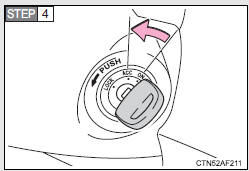
Vehicles without a smart key system: Stop the engine by turning the engine switch to the “ACC” position.
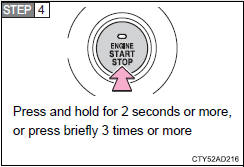
Vehicles with a smart key system:
To stop the engine, press and hold the “ENGINE START STOP” switch for 2 consecutive seconds or more, or press it briefly 3 times or more in succession.
 Stop the vehicle in a safe place
by the road.
CAUTION
- If the engine has to be turned off while driving
• Power assist for the brakes and steering wheel will be lost, making the brake pedal harder to depress and the steering wheel heavier to turn.
Decelerate as much as possible before turning off the engine.
• Vehicles without a smart key system: Never attempt to remove the key, as doing so will lock the steering wheel.
 If the vehicle becomes stuck
Carry out the following procedures if the tires spin or the vehicle becomes
stuck in mud, dirt, or snow.
Stop the engine. Set the parking
brake and shift the shift lever in “P”.
Stop the eng ...
 Vehicle specifications
Detailed vehicle information ...
Other materials about Toyota Venza:
Installation
INSTALLATION
CAUTION / NOTICE / HINT
HINT:
Use the same procedure for the RH side and LH side.
The procedure listed below is for the LH side.
PROCEDURE
1. INSTALL REAR AXLE HUB AND BEARING ASSEMBLY
(a) Apply a total of 0.1 to 0.3g (0.00 ...
Customize Parameters
CUSTOMIZE PARAMETERS
1. CUSTOMIZE METER / GAUGE SYSTEM
(a) Customizing with the Techstream
(1) Connect the Techstream to the DLC3.
(2) Turn the ignition switch to ON.
(3) Turn the Techstream on.
(4) Enter the following menus: Customize Setting / Warning. ...
LVL Terminal Circuit
DESCRIPTION
By connecting terminals LVL and CG of the DLC3, the headlight leveling
ECU assembly initializes the height control sensor signal.
WIRING DIAGRAM
PROCEDURE
1.
CHECK HARNESS AND CONNECTOR (DLC3 - HEADLIGH ...

0.1572