
Toyota Venza: Removal
REMOVAL
CAUTION / NOTICE / HINT
NOTICE:
Release the vacuum from the booster by depressing the brake pedal several times. Then remove the brake master cylinder from the brake booster.
PROCEDURE
1. DRAIN BRAKE FLUID
NOTICE:
If brake fluid leaks onto any painted surface, immediately wash it off.
2. REMOVE AIR CLEANER CAP SUB-ASSEMBLY (for 1AR-FE)
.gif)
3. REMOVE AIR CLEANER CAP SUB-ASSEMBLY (for 2GR-FE)
4. REMOVE AIR CLEANER FILTER ELEMENT SUB-ASSEMBLY
5. REMOVE BRAKE MASTER CYLINDER SUB-ASSEMBLY
|
(a) Disconnect the connector and disengage the clamp. |
|
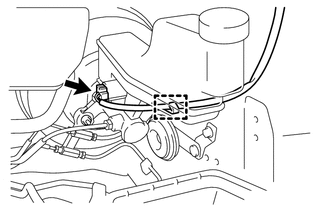
|
(b) Using a union nut wrench, disconnect the 2 brake lines from the front brake tube way. NOTICE:
|
|
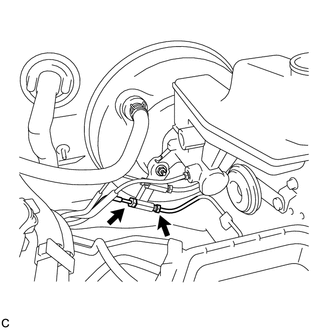
|
(c) Using a union nut wrench, disconnect the 2 brake lines and remove the No. 1 front brake tube from the brake master cylinder sub-assembly. NOTICE:
|
|
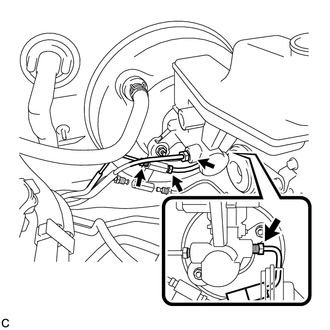
|
(d) Remove the 2 nuts, front brake tube way and brake master cylinder sub-assembly from the brake booster assembly. NOTICE:
|
|
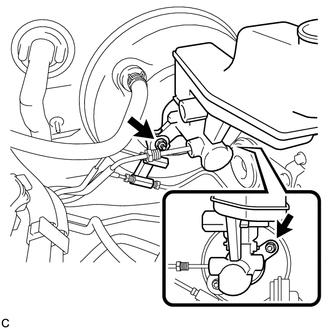
(e) Remove the O-ring from the brake master cylinder sub-assembly.
 Disassembly
DISASSEMBLY
PROCEDURE
1. REMOVE BRAKE MASTER CYLINDER RESERVOIR ASSEMBLY
(a) Mount the brake master cylinder sub-assembly in a vise.
NOTICE:
Place aluminum plates on the vise to prevent damage to ...
 Installation
INSTALLATION
PROCEDURE
1. INSTALL BRAKE MASTER CYLINDER SUB-ASSEMBLY
NOTICE:
When install a new brake master cylinder sub-assembly, remove the protectors
from the piston and outlet ports.
(a) I ...
Other materials about Toyota Venza:
XM Tuner Malfunction (B15BA)
DESCRIPTION
These DTCs are stored when a malfunction occurs in the stereo component tuner
assembly.
DTC No.
DTC Detection Condition
Trouble Area
B15BA
When either of the following conditions is m ...
Throttle / Pedal Position Sensor / Switch "D" Circuit Range / Performance (P2121)
DESCRIPTION
Refer to DTC P2120 (See page ).
HINT:
This DTC relates to the accelerator pedal sensor assembly.
DTC No.
DTC Detection Condition
Trouble Area
P2121
Either of following conditions 1 o ...
Yaw Rate Sensor Communication Stop Mode
DESCRIPTION
Detection Item
Symptom
Trouble Area
Yaw Rate Sensor Communication Stop Mode
"Yaw Rate/Decelerate Sensor" is not displayed on "CAN Bus Check"
screen o ...

0.1642