
Toyota Venza: Removal
REMOVAL
CAUTION / NOTICE / HINT
NOTICE:
Do not remove the oil pump or oil pump relief valve from the timing chain cover sub-assembly.
PROCEDURE
1. INSTALL ENGINE ON ENGINE STAND
(See page .gif) )
)
2. REMOVE IGNITION COIL ASSEMBLY
3. REMOVE CYLINDER HEAD COVER SUB-ASSEMBLY
4. REMOVE CRANKSHAFT POSITION SENSOR
5. REMOVE CRANKSHAFT PULLEY
6. REMOVE ENGINE MOUNTING BRACKET RH
|
(a) Remove the 5 bolts and engine mounting bracket RH. |
|
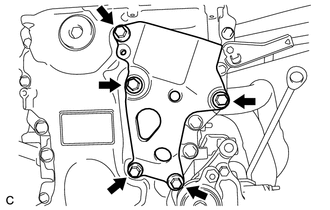
7. REMOVE V-RIBBED BELT TENSIONER ASSEMBLY
8. REMOVE TIMING CHAIN COVER SUB-ASSEMBLY
|
(a) Remove the 17 bolts and 2 nuts. |
|
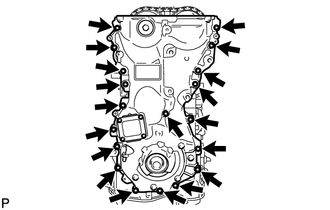
(b) Remove the timing chain cover sub-assembly by prying between the timing chain cover sub-assembly and cylinder head, camshaft housing, cylinder block and stiffening crankcase with a screwdriver as shown in the illustration.
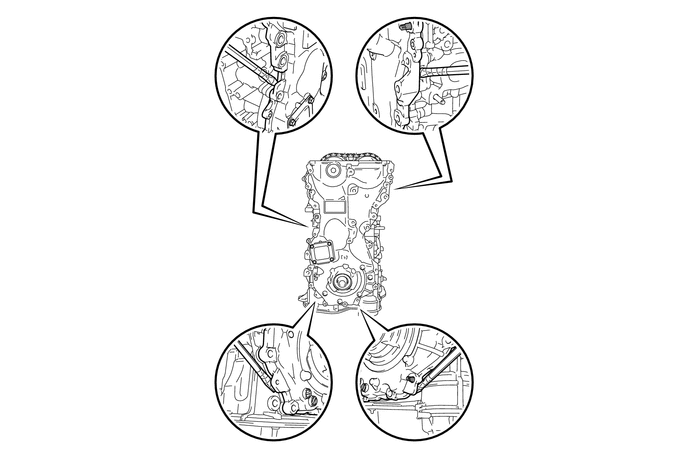
NOTICE:
Be careful not to damage the contact surfaces of the cylinder head, camshaft housing, cylinder block, stiffening crankcase and timing chain cover sub-assembly.
HINT:
Tape the screwdriver tip before use.
|
(c) Remove the 2 oil pump gaskets and oil hole cover gasket from the stiffening crankcase. |
|
.png)
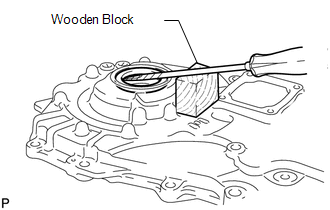
9. REMOVE TIMING CHAIN COVER OIL SEAL
|
(a) Using a screwdriver and wooden block, pry out the timing chain cover oil seal. NOTICE: Do not damage the surface of the timing chain cover oil seal press fit hole. HINT: Tape the screwdriver tip before use. |
|
 Installation
INSTALLATION
PROCEDURE
1. INSTALL TIMING CHAIN COVER SUB-ASSEMBLY
(a) Apply a light coat of engine oil to 2 new oil pump gaskets and new
oil hole cover gasket.
...
 1ar-fe Starting
...
Other materials about Toyota Venza:
Diagnostic Trouble Code Chart
DIAGNOSTIC TROUBLE CODE CHART
Intuitive Parking Assist System
DTC Code
Detection Item
See page
C1AE1
Front Left Sensor Malfunction
C1AE4
Front Right Sensor ...
Registration
REGISTRATION
CAUTION / NOTICE / HINT
NOTICE:
When the automatic transaxle is replaced, the transaxle compensation
code must be input into the TCM (proceed to Procedure 1). After the automatic
transaxle is reinstalled, the Quick Response (QR) ...
Installation
INSTALLATION
CAUTION / NOTICE / HINT
HINT:
Use the same procedure for the RH side and LH side.
The procedure listed below is for the LH side.
PROCEDURE
1. INSTALL FRONT POWER WINDOW REGULATOR MOTOR ASSEMBLY
NOTICE:
The regulator arm mu ...

0.1593