
Toyota Venza: Power Source Circuit
DESCRIPTION
1. w/o Multi-information Display
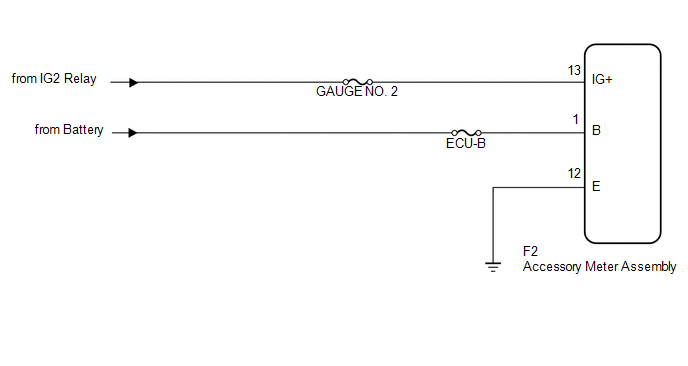
(a) This circuit is the power source circuit for the accessory meter assembly. This circuit provides two types of power sources; one is a constant power source mainly used as a backup power source, and the other is a power source mainly used for signal transmission.
HINT:
If the accessory meter assembly displays "1:00" when the ignition switch is turned off, then to ON again, the B terminal has a malfunction.
The maximum clock assembly margin of error is -4 to 4 seconds per day when the temperature is between -20°C (-4°F) and 60°C (140°F).
2. w/ Multi-information Display
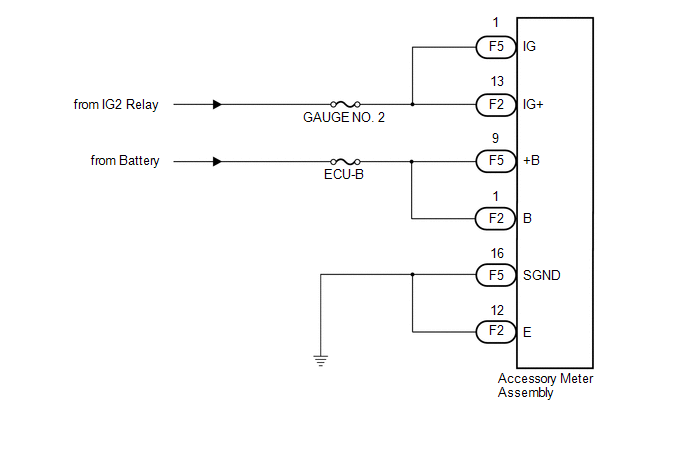
(a) This circuit is the power source circuit for the accessory meter assembly. This circuit provides two types of power sources; one is a constant power source mainly used as a backup power source, and the other is a power source mainly used for signal transmission.
HINT:
If the accessory meter assembly displays "1:00" when the ignition switch is turned off, then to ON again, the +B terminal has a malfunction.
The maximum clock assembly margin of error is -4 to 4 seconds per day when the temperature is between -20°C (-4°F) and 60°C (140°F).
WIRING DIAGRAM
1. w/o Multi-information Display
2. w/ Multi-information Display
PROCEDURE
|
1. |
CHECK HARNESS AND CONNECTOR |
(a) w/o Multi-information Display
|
(1) Disconnect the F2 connector. |
|
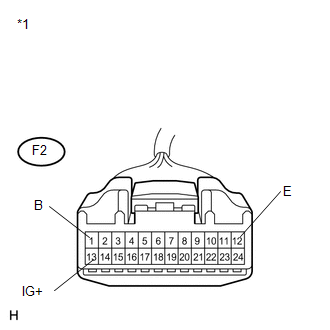
(2) Measure the voltage according to the value(s) in the table below.
Standard Voltage:
|
Tester Connection |
Condition |
Specified Condition |
|---|---|---|
|
F2-1 (B) - Body ground |
Always |
11 to 14 V |
|
F2-13 (IG+) - Body ground |
Ignition switch ON |
11 to 14 V |
(3) Measure the resistance according to the value(s) in the table below.
Standard Resistance:
|
Tester Connection |
Condition |
Specified Condition |
|---|---|---|
|
F2-12 (E) - Body ground |
Always |
Below 1 Ω |
|
*1 |
Front view of wire harness connector (to Accessory Meter Assembly) |
(b) w/ Multi-information Display
|
(1) Disconnect the F2 and F5 connectors. |
|
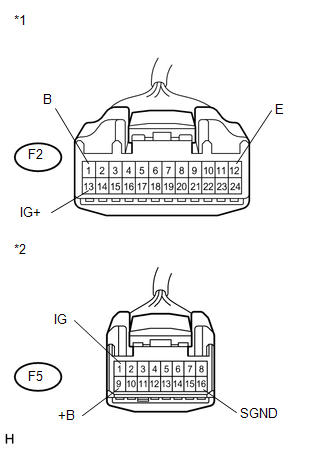
(2) Measure the voltage according to the value(s) in the table below.
Standard Voltage:
|
Tester Connection |
Condition |
Specified Condition |
|---|---|---|
|
F5-1 (IG) - Body ground |
Ignition switch ON |
11 to 14 V |
|
F5-9 (+B) - Body ground |
Always |
11 to 14 V |
|
F2-1 (B) - Body ground |
Always |
11 to 14 V |
|
F2-13 (IG+) - Body ground |
Ignition switch ON |
11 to 14 V |
(3) Measure the resistance according to the value(s) in the table below.
Standard Resistance:
|
Tester Connection |
Condition |
Specified Condition |
|---|---|---|
|
F2-12 (E) - Body ground |
Always |
Below 1 Ω |
|
F5-16 (SGND) - Body ground |
Always |
Below 1 Ω |
|
*1 |
Front view of wire harness connector (to Accessory Meter Assembly) |
|
*2 |
Front view of wire harness connector (to Accessory Meter Assembly ) |
| OK | .gif) |
REPLACE ACCESSORY METER ASSEMBLY |
| NG | |
REPAIR OR REPLACE HARNESS OR CONNECTOR |
 Speed Signal Circuit
DESCRIPTION
The combination meter assembly receives the vehicle speed signal from this circuit.
The wheel speed sensors produce an output that varies according to the vehicle speed.
The wheel spe ...
 Mirror (int)
...
Other materials about Toyota Venza:
Towing with a wheel lift-type truck
►From the front (2WD models)
Release the parking brake.
►From the front (AWD models)
Use a towing dolly under the rear wheels.
► From the rear
Use a towing dolly under the front wheels. ...
Operation Check
OPERATION CHECK
1. CHECK BASIC FUNCTIONS
(a) When the back door is partially closed, check that the motor operates to
fully close (lock) the back door.
(b) Check that the back door can be opened.
(c) When the back door is partially closed and then the mo ...
Data List / Active Test
DATA LIST / ACTIVE TEST
1. DATA LIST
HINT:
Using the Techstream to read the Data List allows the values or states of switches,
sensors, actuators and other items to be read without removing any parts. This non-intrusive
inspection can be very useful bec ...

0.1338