
Toyota Venza: Inspection
INSPECTION
PROCEDURE
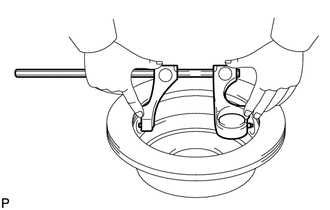
1. INSPECT BRAKE DISC INSIDE DIAMETER
|
(a) Using a brake drum gauge or an equivalent tool, measure the inside diameter of the disc. Standard inside diameter of a new disc: 190 mm (7.48 in.) Maximum inside diameter: 191 mm (7.52 in.) If the inside diameter is more than the maximum, replace the rear disc. |
|
2. INSPECT PARKING BRAKE SHOE LINING THICKNESS
|
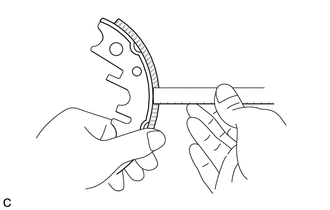
(a) Using a ruler, measure the thickness of the parking brake shoe lining. Standard thickness: 2.45 mm (0.0965 in.) Minimum thickness: 1.0 mm (0.0394 in.) If the lining thickness is less than the minimum, or if there is severe or uneven wear, replace the parking brake shoe assembly. NOTICE: Always replace both the right and left parking brake shoes together. |
|
3. INSPECT BRAKE DISC AND PARKING BRAKE SHOE LINING FOR PROPER CONTACT
|
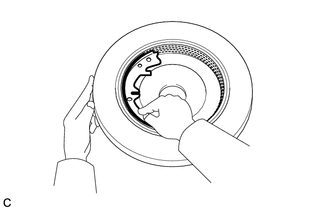
(a) Apply chalk to the inside surface of the disc, then grind down the brake shoe lining to fit the disc. If the contact between the disc and the brake shoe lining is incorrect, repair it using a brake shoe grinder or replace the parking brake shoe assembly. NOTICE: Always replace both the right and left parking brake shoes together. |
|
 Disassembly
DISASSEMBLY
CAUTION / NOTICE / HINT
HINT:
Use the same procedure for the RH side and the LH side.
The procedure listed below is for the LH side.
PROCEDURE
1. REMOVE REAR WHEEL
...
 Reassembly
REASSEMBLY
CAUTION / NOTICE / HINT
NOTICE:
Before installation, apply high temperature grease to the parts indicated by
arrows (See page ).
PROCEDURE
1. INSTALL NO. 2 PARKING BRAKE SHOE HOLD D ...
Other materials about Toyota Venza:
Reassembly
REASSEMBLY
PROCEDURE
1. INSTALL MAGNETIC CLUTCH ASSEMBLY
(a) Install the magnetic clutch stator while aligning the protrusion
on the stator with the notch on the air compressor assembly as shown in
the illustration.
...
Operation Check
OPERATION CHECK
1. CHECK FUNCTION
(a) Check that the key reminder warning buzzer sounds.
(1) With the driver side door closed, insert the key into the ignition key cylinder
and then make sure that the key is in LOCK or ACC.
(2) Check that the buzzer soun ...
Power Mirror Surface Position is not Memorized
SYSTEM DESCRIPTION
If either the M1 or M2 seat memory switch is pressed, the outer mirror control
ECU assembly (driver door) detects the switch operation and sends the seat memory
switch signal to the main body ECU (driver side junction block assembly) vi ...

0.1294