
Toyota Venza: Inspection
INSPECTION
PROCEDURE
1. INSPECT TIRES
(a) Inspect the tires for wear and proper inflation pressure.
Cold Tire Inflation Pressure:
|
Tire Size |
Front kPa (kgf/cm2, psi) |
Rear kPa (kgf/cm2, psi) |
|---|---|---|
|
P245/55R19 103S P245/50R20 102H |
220 (2.2, 32) |
220 (2.2, 32) |
|
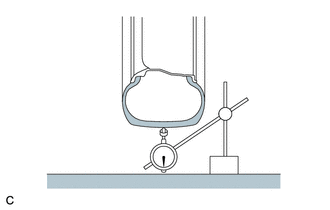
(b) Using a dial indicator, inspect the runout of the tires. Maximum Tire Runout: 1.4 mm (0.0551 in.) |
|
2. ROTATE TIRES
(a) Rotate the tires as shown in the illustration.
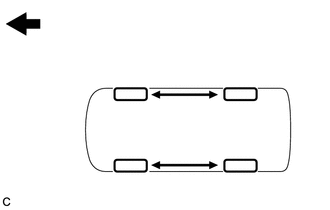 Text in Illustration
.png) |
Front |
Torque:
103 N·m {1050 kgf·cm, 76 ft·lbf}
3. INSPECT WHEEL BALANCE
|
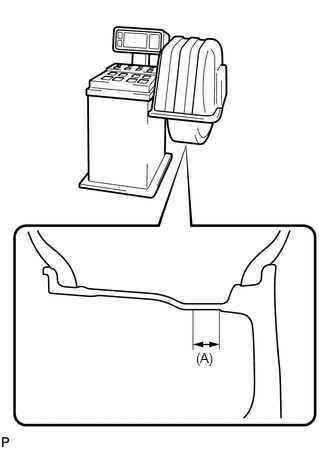
(a) Check and adjust the off-the-car balance. Maximum Wheel Imbalance After Adjustment: 8.0 g (0.0176 lb) NOTICE:
HINT: Use clip-on type balance weights for the inner side, and stick-on type balance weights for the outer side. |
|
4. INSPECT FRONT AXLE HUB BEARING LOOSENESS
(a) Inspect the front axle hub bearing looseness (See page
.gif) ).
).
5. INSPECT REAR AXLE HUB BEARING LOOSENESS (for 2WD)
(a) Inspect the rear axle hub bearing looseness (See page
).
6. INSPECT REAR AXLE HUB BEARING LOOSENESS (for AWD)
(a) Inspect the rear axle hub bearing looseness (See page
).
7. INSPECT FRONT AXLE HUB RUNOUT
(a) Inspect the front axle hub runout (See page
).
8. INSPECT REAR AXLE HUB RUNOUT (for 2WD)
(a) Inspect the rear axle hub runout (See page
).
9. INSPECT REAR AXLE HUB RUNOUT (for AWD)
(a) Inspect the rear axle hub runout (See page
).
 How To Proceed With Troubleshooting
PROCEDURE
1.
CHECK TIRE AND WHEEL SYSTEM
DIAGNOSIS OF IRREGULAR TIRE WEAR
GO TO STEP 11
DIAGNOSIS OF TIRE VIBRATIO ...

Other materials about Toyota Venza:
Removal
REMOVAL
PROCEDURE
1. REMOVE FRONT DOOR SCUFF PLATE LH
2. REMOVE COWL SIDE TRIM SUB-ASSEMBLY LH
3. REMOVE LOWER NO. 1 INSTRUMENT PANEL FINISH PANEL
4. REMOVE OUTER MIRROR SWITCH ASSEMBLY
(a) Disengage the 2 claws and remove the outer m ...
System Diagram
SYSTEM DIAGRAM
Communication Method
Transmitting ECU
Receiver
Signal
Communication Method
Main body ECU (Driver Side Junction Block Assembly)
Power back door ECU (Power back door motor ...
Freeze Frame Data
FREEZE FRAME DATA
1. CHECK FREEZE FRAME DATA
(a) Connect the Techstream to the DLC3.
(b) Turn the ignition switch to ON.
(c) Turn the Techstream on.
(d) Enter the following menus: Body Electrical / Navigation System / Trouble
Codes.
(e) Select a DTC to ...

0.1434