
Toyota Venza: Do-it-yourself service precautions
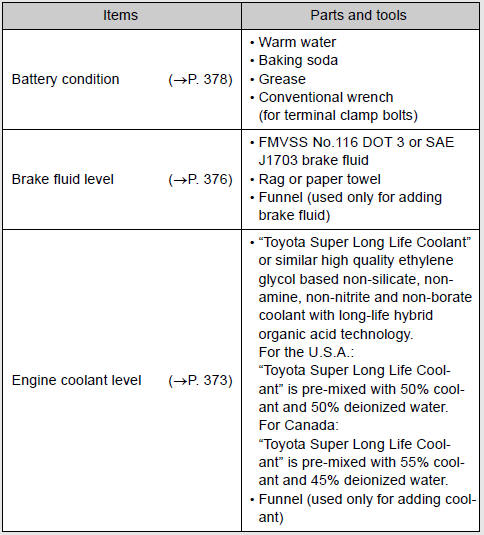
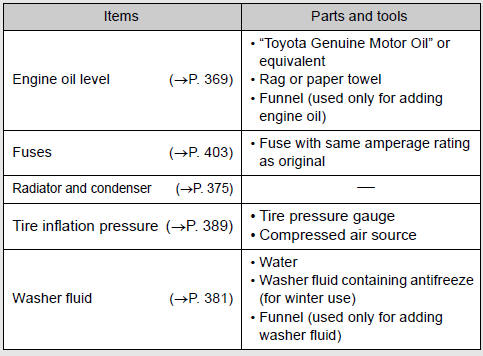
If you perform maintenance yourself, be sure to follow the correct procedure given in these sections.
CAUTION
The engine compartment contains many mechanisms and fluids that may move suddenly, become hot, or become electrically energized. To avoid death or serious injury observe the following precautions.
- When working on the engine compartment
• Keep hands, clothing, and tools away from the moving fan and engine drive belt.
• Be careful not to touch the engine, inverter, radiator, exhaust manifold, etc.
right after driving as they may be hot. Oil and other fluids may also be hot.
• Do not leave anything that may burn easily, such as paper or rags, in the engine compartment.
• Do not smoke, cause sparks or expose an open flame to fuel or the battery.
Fuel and battery fumes are flammable.
• Be extremely cautious when working on the battery. It contains poisonous and corrosive sulfuric acid.
CAUTION
- When working near the electric cooling fan or radiator grille
►Vehicles with smart key system Be sure the “ENGINE START STOP” switch is off. With the “ENGINE START STOP” switch in IGNITION ON mode, the electric cooling fan may automatically start to run if the air conditioning is on and/or if the coolant temperature is high.
►Vehicles without smart key system Be sure the engine switch is in the “LOCK” position. With the engine switch in the “ON” position, the electric cooling fan may automatically start to run if the air conditioning is on and/or if the coolant temperature is high.
- When working on or under the vehicle
Do not get under the vehicle with just the jack supporting it.
Always use automotive jack stands or other solid supports.
- Safety glasses
Wear safety glasses to prevent flying or falling material, fluid spray, etc. from
getting in your eyes.
NOTICE
- If you remove the air cleaner filter
Driving with the air cleaner filter removed may cause excessive engine wear due to dirt in the air. Also a backfire could cause a fire in the engine compartment.

 Hood
Hood
Release the lock from the inside of the vehicle to open the hood.
Pull the hood release lever.
The hood will pop up slightly.
Lift the hood catch and lift the hood.
Hold the hood open by ins ...
Other materials about Toyota Venza:
CD Sound Skips
PROCEDURE
1.
CHECK CD
(a) Check that the CD is not deformed or cracked.
OK:
No deformation or cracks on the CD.
NG
END (CD IS FAULTY)
...
Power Back Door Warning Buzzer
Components
COMPONENTS
ILLUSTRATION
Inspection
INSPECTION
PROCEDURE
1. INSPECT POWER BACK DOOR WARNING BUZZER
(a) Measure the resistance according to the value(s) in the table below.
HINT:
If battery voltage is applied directly to ...
Vehicle Speed Signal Malfunction (B2282)
DESCRIPTION
The power management control ECU receives vehicle speed information using 2 methods.
It receives a speed signal from the meter ECU. It also receives speed information
from the meter ECU via CAN. If the information sent using these 2 methods is ...

0.1374