
Toyota Venza: Removal
REMOVAL
PROCEDURE
1. REMOVE RADIATOR ASSEMBLY AND FAN ASSEMBLY WITH MOTOR
HINT:
See page .gif)
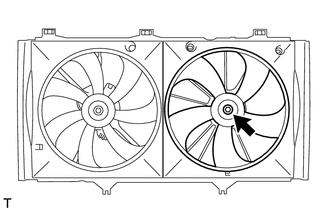
2. REMOVE FAN
|
(a) Remove the nut and fan. |
|
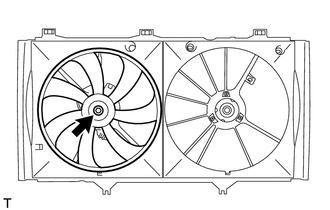
3. REMOVE NO. 2 FAN
|
(a) Remove the nut and No. 2 fan. |
|
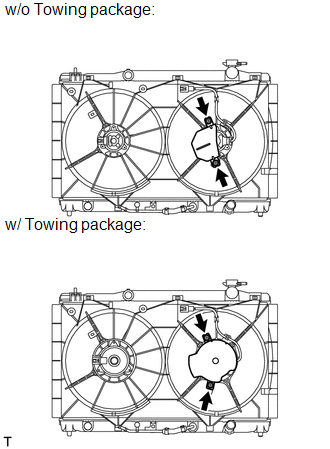
4. REMOVE COOLING FAN MOTOR INSULATOR
|
(a) Remove the 2 bolts and cooling fan motor insulator. |
|
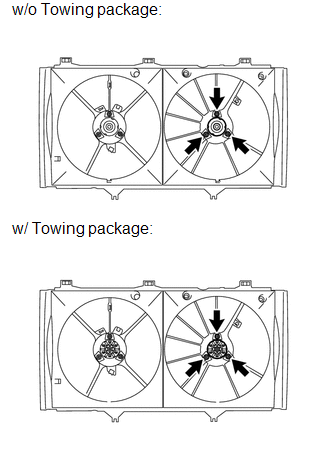
5. REMOVE COOLING FAN MOTOR
|
(a) Remove the 3 screws and cooling fan motor. |
|
6. REMOVE NO. 2 COOLING FAN MOTOR
|
(a) Disconnect the No. 2 cooling fan motor connector and 2 clamps. |
|
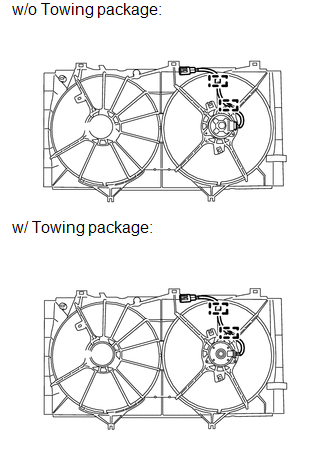
|
(b) Remove the 3 screws and No. 2 cooling fan motor. |
|
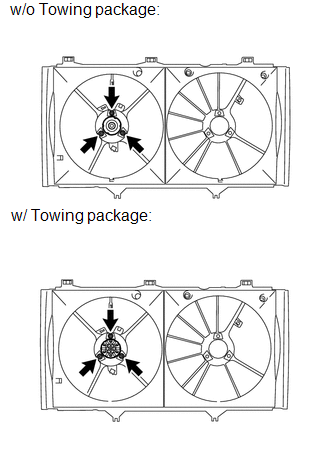
 On-vehicle Inspection
ON-VEHICLE INSPECTION
PROCEDURE
1. INSPECT COOLING FAN MOTOR
(a) Check that the motor operates smoothly when the battery is connected
to the cooling fan motor connector.
Text in I ...
 Installation
INSTALLATION
PROCEDURE
1. INSTALL NO. 2 COOLING FAN MOTOR
(a) Install the No. 2 cooling fan motor with the 3 screws.
Torque:
w/o Towing package :
2.6 N·m {26 kgf·cm, 23 in· ...
Other materials about Toyota Venza:
Disassembly
DISASSEMBLY
PROCEDURE
1. INSPECT CONNECTING ROD THRUST CLEARANCE
(a) Using a dial indicator, measure the thrust clearance while moving
the connecting rod back and forth.
Standard thrust clearance:
0.160 to 0.512 mm (0.00630 to 0.0202 i ...
Dtc Check / Clear
DTC CHECK / CLEAR
1. CHECK DTC
(a) Connect the Techstream to the DLC3.
(b) Turn the ignition switch to ON.
(c) Turn the Techstream on.
(d) Enter the following menus: Body Electrical / Back Door / DTC.
HINT:
Refer to the Techstream operator's manual ...
Setting up the displays
Press the “SETUP” button while the
vehicle is stopped.
The “Custom Settings” screen is displayed on the multi-information display.
If left idle for approximately 10 seconds, the display will revert to the previous
screen.
Select “Display / ...

0.1314