
Toyota Venza: Removal
REMOVAL
PROCEDURE
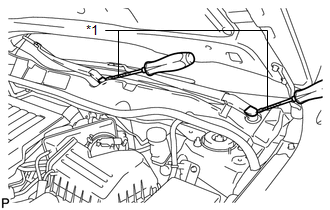
1. REMOVE FRONT WIPER ARM HEAD CAP
|
(a) Using a screwdriver, remove the 2 front wiper arm head caps as shown in the illustration. Text in Illustration
HINT: Tape the screwdriver tip before use. |
|
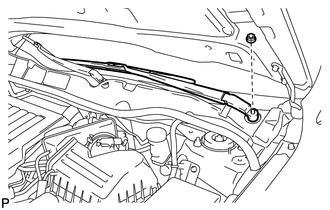
2. REMOVE FRONT WIPER ARM AND BLADE ASSEMBLY LH
|
(a) Remove the nut and the front wiper arm and blade assembly LH. |
|
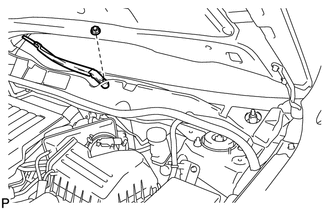
3. REMOVE FRONT WIPER ARM AND BLADE ASSEMBLY RH
|
(a) Remove the nut and the front wiper arm and blade assembly RH. |
|
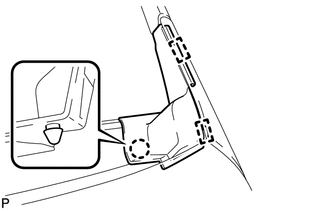
4. REMOVE FRONT FENDER TO COWL SIDE SEAL LH
|
(a) Disengage the claw and 2 guides and remove the front fender to cowl side seal LH. |
|
5. REMOVE FRONT FENDER TO COWL SIDE SEAL RH
HINT:
Use the same procedure for the RH side and LH side.
6. REMOVE COWL TOP VENTILATOR LOUVER SUB-ASSEMBLY
|
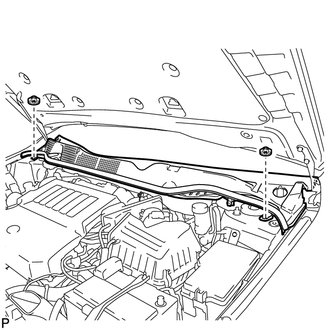
(a) Using a clip remover, remove the 2 clips. |
|
|
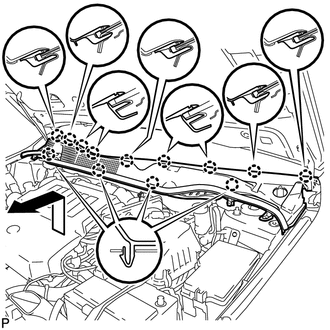
(b) Disengage the 13 claws and pull out the cowl top ventilator louver sub-assembly as shown in the illustration. |
|
7. REMOVE WINDSHIELD WIPER MOTOR AND LINK ASSEMBLY
|
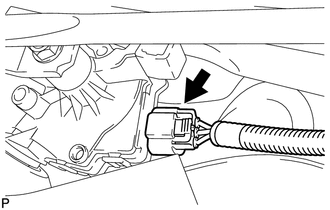
(a) Disconnect the connector. |
|
|
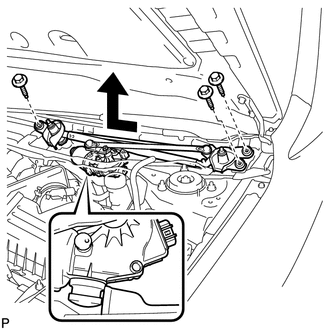
(b) Remove the 3 bolts and the windshield wiper motor and link assembly as shown in the illustration. |
|
8. REMOVE WINDSHIELD WIPER MOTOR ASSEMBLY
|
(a) Using a screwdriver, disengage the windshield wiper link rod from the crank arm pivot of the front wiper motor assembly as shown in the illustration. Text in Illustration
HINT: Tape the screwdriver tip before use. |
|
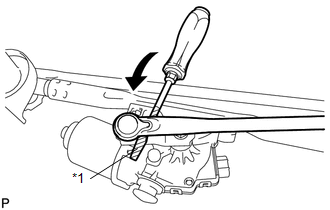
|
(b) Using a T30 "TORX" socket wrench, remove the 2 bolts and the windshield wiper motor assembly from the windshield wiper link assembly. |
|
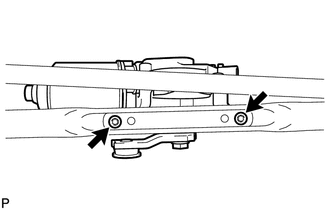
 Inspection
INSPECTION
CAUTION / NOTICE / HINT
NOTICE:
Ensure that fingers or articles of clothing do not get caught in moving parts
when performing this test.
PROCEDURE
1. INSPECT WINDSHIELD WIPER MOTOR A ...
 Installation
INSTALLATION
PROCEDURE
1. INSTALL WINDSHIELD WIPER MOTOR ASSEMBLY
(a) Using a T30 "TORX" socket wrench, install the windshield wiper motor
assembly with the 2 bolts.
Tor ...
Other materials about Toyota Venza:
Removal
REMOVAL
CAUTION / NOTICE / HINT
CAUTION:
Wear protective gloves when removing the exhaust pipe.
The exhaust pipe is extremely hot immediately after the engine has stopped.
Confirm that the exhaust pipe has cooled down ...
Room Oscillator does not Recognize Key
DESCRIPTION
If the room oscillator does not recognize a key, one of the following may be
the cause: 1) communication between the indoor electrical key oscillator (for front
floor) and key cannot be performed; 2) communication between the indoor electrical ...
System Description
SYSTEM DESCRIPTION
1. SYSTEM DESCRIPTION
(a) The Electronic Controlled Automatic Transaxle (ECT) is an automatic transaxle
that has its shift timing electronically controlled by the Transmission Control
Module (TCM). The TCM detects electrical signals th ...

0.1471