
Toyota Venza: Precaution
PRECAUTION
CAUTION:
Replace any faulty seat belt components (outer belt, inner belt, bolts, nuts, adjustable shoulder anchor, tether anchor hardware and other related parts). When inspecting a vehicle that was in a collision, be sure to check all of the seat belt systems regardless of whether or not the system was activated in the collision. Replace any damaged or malfunctioning components.
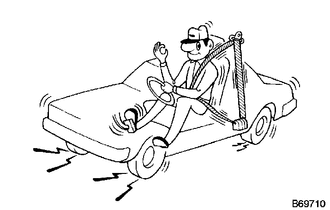
1. ROAD TEST (IN SAFE AREA)
CAUTION:
Conduct this test in a safe area.
HINT:
This road test should be performed with the driver seat and the front passenger seat occupied.
(a) Fasten the front seat belts.
(b) Drive the vehicle at 16 km/h (10 mph) and firmly depress the brake pedal.
Check that the belts lock and cannot be extended at this time. If a belt does not
lock, replace the seat belt assembly (See page
.gif) ).
).
HINT:
Inspect the seat belt assembly before installing it (See page
).
 Components
COMPONENTS
ILLUSTRATION
...
 Removal
REMOVAL
PROCEDURE
1. DISCONNECT CABLE FROM NEGATIVE BATTERY TERMINAL
CAUTION:
Wait at least 90 seconds after disconnecting the cable from the negative (-)
battery terminal to disable the SRS sys ...
Other materials about Toyota Venza:
IG Power Source Circuit
DESCRIPTION
The main power source is supplied to the A/C amplifier when the ignition switch
is ON.
The power source is used for operating the A/C amplifier and servo motor, etc.
WIRING DIAGRAM
CAUTION / NOTICE / HINT
NOTICE:
Inspect the fuses for cir ...
Ignition Switch Circuit
DESCRIPTION
The main body ECU (driver side junction block assembly) determines the ignition
switch position (OFF, ACC, ON) based on signals from the IG or ACC circuit.
WIRING DIAGRAM
PROCEDURE
1.
READ VALUE USING TECHSTREAM
...
Lost Communication with ECM / PCM (U0100)
DESCRIPTION
DTC No.
DTC Detection Condition
Trouble Area
U0100
No communication from the ECM continues.
ECM main wire or connector
Power source circuit of ECM
ECM
...

0.1579