
Toyota Venza: Removal
REMOVAL
CAUTION / NOTICE / HINT
HINT:
- The front side fix window assembly can be reused. When installing the window, if any of the clips on the front side fix window assembly are broken, butyl tape can be used to support the glass until the applied adhesive hardens.
- When using butyl tape to temporarily secure the window, make sure that the butyl tape is not applied exactly at the original clip location. If the butyl tape is applied exactly at the clip location, it will cause the window to protrude.
- Use the same procedure for the RH side and LH side.
- The procedure listed below is for the LH side.
PROCEDURE
1. DISCONNECT FRONT DOOR OPENING TRIM WEATHERSTRIP
(a) Remove the front part of the front door opening trim weatherstrip to the extent that allows removal of the front pillar garnish.
2. REMOVE FRONT PILLAR GARNISH
.gif)
3. REMOVE FRONT PILLAR GARNISH CORNER PIECE (for 6 Speakers)
4. REMOVE FRONT PILLAR GARNISH CORNER PIECE (for 13 Speakers)
5. REMOVE FRONT SIDE FIX WINDOW ASSEMBLY
|
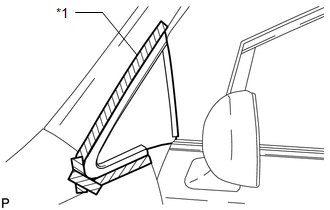
(a) Apply protective tape to the installation position of the front side fix window assembly on the vehicle body. Text in Illustration
|
|
|
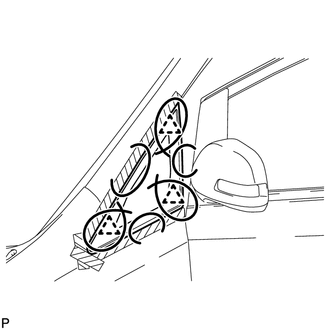
(b) Place matchmarks on the front side fix window assembly and vehicle body on the locations indicated in the illustration. Text in Illustration
HINT: Matchmarks are not necessary if the front side fix window assembly is not going to be reused. |
|
.png)
|
(c) Pass a piano wire between the interior vehicle body and glass from the interior as shown in the illustration. HINT: Do not allow the piano wire to interfere with the clips. |
|
(d) Tie both wire ends to wooden blocks or similar objects that can serve as handles.
NOTICE:
When separating the front side fix window assembly from the vehicle, be careful not to damage the paint or interior and exterior ornaments.
(e) Cut off the adhesive by pulling the piano wire around the front side fix window assembly.
NOTICE:
Leave as much adhesive on the vehicle body as possible when cutting through the adhesive.
|
(f) Disengage the 3 clips. |
|
.png)
(g) Using suction cups, remove the glass.
NOTICE:
Be careful not to drop the glass.
6. CLEAN VEHICLE BODY
|
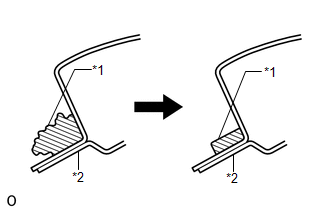
(a) Clean and shape the contact surfaces of the vehicle body. Text in Illustration
(1) Using a knife, cut away excess adhesive on the contact surfaces of the vehicle body as shown in the illustration. NOTICE: Be careful not to damage the vehicle body. HINT: Leave as much adhesive on the vehicle body as possible. |
|
(b) Clean the contact surfaces of the vehicle body with a piece of cloth saturated with cleaner.
HINT:
Even if all the adhesive has been removed, clean the vehicle body.
 Installation
INSTALLATION
PROCEDURE
1. CLEAN FRONT SIDE FIX WINDOW ASSEMBLY
(a) Clean the outer edges of the front side fix window assembly with
a non-residue solvent.
NOTICE:
...

Other materials about Toyota Venza:
Operation Check
OPERATION CHECK
1. NOTICE WHEN CHECKING THE FOLLOWING
(a) Power door lock/unlock function:
This wireless door lock control function operates only when the following 3 conditions
are met:
(1) There is no key in the ignition key cylinder.
(2) All doors ar ...
Rear Airbag Sensor RH Circuit Malfunction (B1630/23)
DESCRIPTION
The side collision sensor RH circuit (to determine deployment of the front seat
side airbag assembly RH and curtain shield airbag assembly RH) is composed of the
center airbag sensor assembly, rear airbag sensor RH and side airbag sensor RH.
...
Air Conditioning Panel
Components
COMPONENTS
ILLUSTRATION
Installation
INSTALLATION
PROCEDURE
1. INSTALL AIR CONDITIONING CONTROL ASSEMBLY
(a) Connect the connector.
(b) Engage the 2 clips and 4 guides.
(c) Rem ...

0.159