
Toyota Venza: Engine coolant
The coolant level is satisfactory if it is between the “F” and “L” lines on the reservoir when the engine is cold.
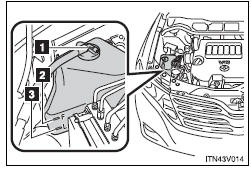
1. Reservoir cap
2. Full
3. Low
If the level is on or below the “L” line, add coolant up to the “F” line.
- If the coolant level drops within a short time after replenishing
Visually check the radiator, hoses, reservoir cap, radiator cap, drain cock and water pump.
If you cannot find a leak, have your Toyota dealer pressure test the cap and check for leaks in the cooling system.
- Coolant selection
Only use “Toyota Super Long Life Coolant” or similar high quality ethylene glycol based non-silicate, non-amine, non-nitrite, and non-borate coolant with long-life hybrid organic acid technology.
U.S.A.: “Toyota Super Long Life Coolant” is a mixture of 50% coolant and 50% deionized water. (Enabled: -31°F [-35°C])
Canada: “Toyota Super Long Life Coolant” is a mixture of 55% coolant and 45% deionized water. (Enabled: -44°F [-42°C])
For more details about engine coolant, contact your Toyota dealer.
CAUTION
- When the engine is hot
Do not remove the radiator cap.
The cooling system may be under pressure and may spray hot coolant if the cap is removed, causing serious injuries, such as burns.
NOTICE
- When adding the engine coolant
Coolant is neither plain water nor straight antifreeze. The correct mixture of water and antifreeze must be used to provide proper lubrication, corrosion protection and cooling. Be sure to read the antifreeze or coolant label.
- If you spill coolant
Be sure to wash it off with water to prevent damage to parts or paint.
 Engine oil
With the engine at operating temperature and turned off, check the oil level
on the dipstick.
- Checking the engine oil
Park the vehicle on level ground.
After warming up the engine and t ...
 Radiator and condenser
Check the radiator and condenser and clear any foreign objects.
If either of the above parts are extremely dirty or you are not sure of their
condition, have your vehicle checked by your Toyota dea ...
Other materials about Toyota Venza:
On-vehicle Inspection
ON-VEHICLE INSPECTION
PROCEDURE
1. CONNECT TECHSTREAM
(a) Connect the Techstream to the DLC3.
(b) Start the engine and run it at idle.
(c) Enter the following menus: Chassis / ABS/VSC/TRAC / Active Test.
HINT:
Refer to the Techstream operator's manu ...
Terminals Of Ecu
TERMINALS OF ECU
1. OCCUPANT CLASSIFICATION ECU (for Power Seat)
Terminal No. (Symbol)
Wiring Color
Terminal Description
Condition
Specification
S12-1 (+B) - S12-3 (GND)
GR ...
System Description
SYSTEM DESCRIPTION
1. DESCRIPTION OF SYSTEM
(a) Each tire pressure warning valve and transmitter is equipped with a tire
pressure sensor and a transmitter and is installed in each tire and wheel assembly.
The sensor measures the tire pressure. The measur ...

0.165