
Toyota Venza: Installing child restraints using a seat belt (child restraint lock function belt)
- Rear-facing -- Infant seat/convertible seat
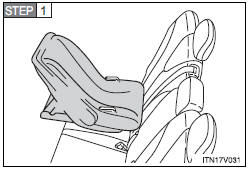
Place the child restraint system on the rear seat facing the rear of the vehicle.
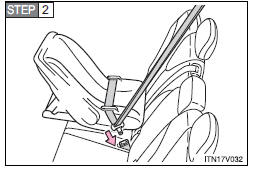
Run the seat belt through the child restraint system and insert the plate into the buckle. Make sure that the belt is not twisted.
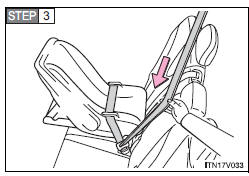
Fully extend the shoulder belt and then allow it to retract slightly in order to activate the ALR lock mode.
Lock mode allows the seat belt to retract only.
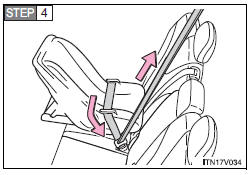
While pushing the child restraint system down into the rear seat, allow the shoulder belt to retract until the child restraint system is securely in place.
After the shoulder belt has retracted to a point where there is no slack in the belt, pull the belt to check that it cannot be extended.
- Forward-facing -- Convertible seat
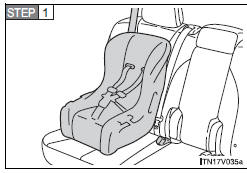
Place the child restraint system on the seat facing the front of the vehicle.
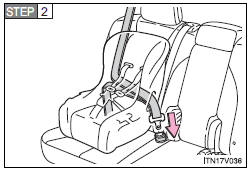
Run the seat belt through the child restraint system and insert the plate into the buckle. Make sure that the belt is not twisted.
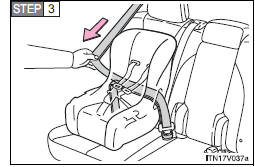
Fully extend the shoulder strap and then allow it to retract slightly into the ALR lock mode.
Lock mode allows the seat belt to retract only.
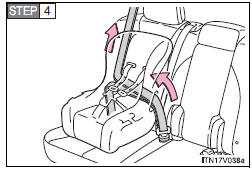
While pushing the child restraint system into the rear seat, allow the shoulder belt to retract until the child restraint system is securely in place.
After the shoulder belt has retracted to a point where there is no slack in the belt, pull the belt to check that it cannot be extended.

If the child restraint has a top tether strap, the top tether strap should be latched onto the top tether strap anchor.
- Booster seat
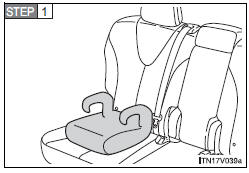
Place the booster seat on the seat facing the front of the vehicle.
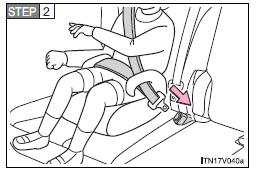
Sit the child in the booster seat.
Fit the seat belt to the booster seat according to the manufacturer’s instructions and insert the plate into the buckle. Make sure that the belt is not twisted.
Check that the shoulder belt is correctly positioned over the child’s shoulder, and that the lap belt is as low as possible.
 Installing child restraints
Follow the child restraint system manufacturer’s instructions. Firmly secure
child restraints to the rear seats using the LATCH anchors or a seat belt. Attach
the top tether strap when installin ...
 Removing a child restraint installed with a seat belt
Press the buckle release button and fully retract the seat belt. ...
Other materials about Toyota Venza:
Removal
REMOVAL
PROCEDURE
1. DISCONNECT CABLE FROM NEGATIVE BATTERY TERMINAL
CAUTION:
Wait at least 90 seconds after disconnecting the cable from the negative (-)
battery terminal to disable the SRS system.
NOTICE:
When disconnecting the cable, some systems ne ...
Camshaft Position "B" Actuator Circuit / Open (Bank 1) (P0013)
DESCRIPTION
The Variable Valve Timing (VVT) system adjusts the exhaust valve timing to improve
driveability. The engine oil pressure turns the VVT controller to adjust the valve
timing.
The camshaft timing oil control valve is a solenoid valve and switch ...
Disassembly
DISASSEMBLY
PROCEDURE
1. REMOVE PROPELLER SHAFT
(a) Place matchmarks on both flanges.
Text in Illustration
*1
Matchmark
(b) Remove the 4 nuts, ...

0.1128