
Toyota Venza: Knock Sensor
Components
COMPONENTS
ILLUSTRATION
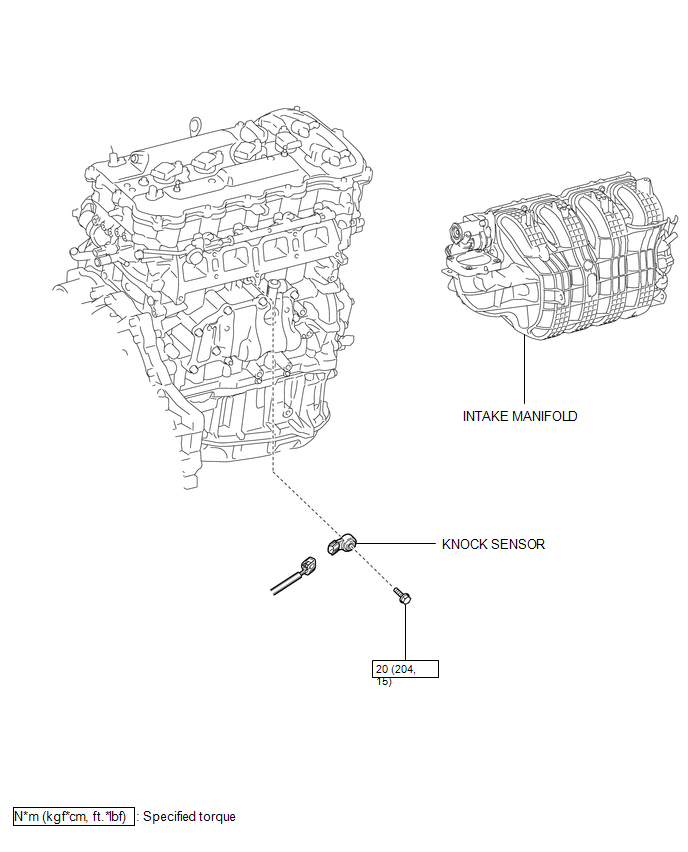
Removal
REMOVAL
PROCEDURE
1. REMOVE INTAKE MANIFOLD
(a) Remove the intake manifold (See page .gif) ).
).
2. REMOVE KNOCK SENSOR
|
(a) Disconnect the sensor connector. |
|
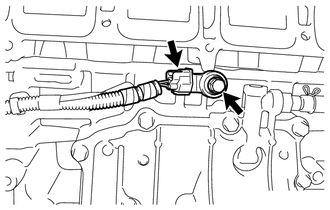
(b) Remove the bolt and sensor.
Inspection
INSPECTION
PROCEDURE
1. INSPECT KNOCK SENSOR
|
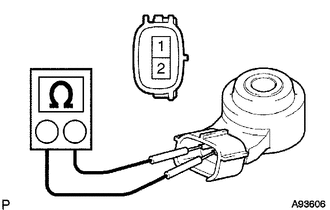
(a) Measure the resistance according to the value(s) in the table below. Standard Resistance:
If the result is not as specified, replace the knock sensor. |
|
Installation
INSTALLATION
PROCEDURE
1. INSTALL KNOCK SENSOR
|
(a) Install the sensor with the bolt so that the sensor is angled as shown in the illustration. Torque: 20 N·m {204 kgf·cm, 15 ft·lbf} NOTICE: The acceptable installation angle of the sensor is between 7° upward and 10° downward from the horizontal position. HINT: Perform "Inspection After Repair" after replacing the knock control sensor
(See page |
|
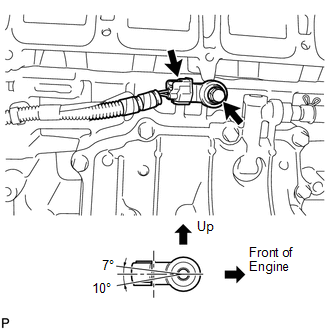
(b) Connect the sensor connector.
2. INSTALL INTAKE MANIFOLD
(a) Install the intake manifold (See page .gif)
).
 On-vehicle Inspection
ON-VEHICLE INSPECTION
PROCEDURE
1. PERFORM SPARK TEST
(a) Check for DTCs (See page ).
NOTICE:
If any DTC is output, perform troubleshooting procedures for that DTC.
(b) Remove the ignition coil ...
 Mass Air Flow Meter
Components
COMPONENTS
ILLUSTRATION
On-vehicle Inspection
ON-VEHICLE INSPECTION
CAUTION / NOTICE / HINT
NOTICE:
Perform the mass air flow meter inspection according to the procedur ...
Other materials about Toyota Venza:
Lost Communication with ECM / PCM "A" (U0100)
DESCRIPTION
The power management control ECU receives shift position information from 2 sources.
It receives a shift position P signal from the shift lock control unit assembly
via a direct line, and shift position information from the ECM via CAN. If the ...
Removal
REMOVAL
PROCEDURE
1. DISCONNECT CABLE FROM NEGATIVE BATTERY TERMINAL
CAUTION:
Wait at least 90 seconds after disconnecting the cable from the negative (-)
battery terminal to disable the SRS system.
NOTICE:
When disconnecting the cable, some systems ne ...
On-vehicle Inspection
ON-VEHICLE INSPECTION
CAUTION / NOTICE / HINT
CAUTION:
Be sure to follow the correct removal and installation procedures of the curtain
shield airbag assembly.
PROCEDURE
1. INSPECT CURTAIN SHIELD AIRBAG ASSEMBLY (VEHICLE NOT INVOLVED IN COLLISION)
(a) ...

0.2172