
Toyota Venza: Inspection
INSPECTION
PROCEDURE
1. INSPECT DRIVE MONITOR SWITCH
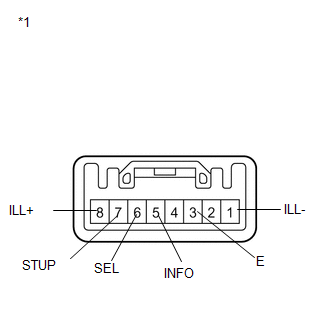
(a) Measure the resistance according to the value(s) in the table below.
Standard Resistance:
|
Tester Connection |
Condition |
Specified Condition |
|---|---|---|
|
3 (E) - 5 (INFO) |
INFO CLOCK*1 or INFO*2 switch is pressed |
Below 1 Ω |
|
3 (E) - 5 (INFO) |
INFO CLOCK*1 or INFO*2 switch is released |
10 kΩ or higher |
|
3 (E) - 6 (SEL) |
RESET H *1 or SELECT RESET*2 switch is pressed |
Below 1 Ω |
|
3 (E) - 6 (SEL) |
RESET H *1 or SELECT RESET*2 switch is released |
10 kΩ or higher |
|
3 (E) - 7 (STUP) |
US/M M*1 or SETUP*2 switch is pressed |
Below 1 Ω |
|
3 (E) - 7 (STUP) |
US/M M*1 or SETUP*2 switch is released |
10 kΩ or higher |
- *1: w/o Rear View Monitor System
- *2: w/ Rear View Monitor System
(b) Apply battery voltage from the wire harness back side between the terminals of the switch, and check the lighting condition of the drive monitor switch.
OK:
|
Measurement Condition |
Condition |
Specified Condition |
|---|---|---|
|
Battery negative (-) → 1 (ILL-) Battery positive (+) → 8 (ILL+) |
Always |
Drive monitor switch illuminates |
|
*1 |
Component without harness connected (Drive Monitor Switch) |
HINT:
If the result is not as specified, replace the drive monitor switch (See page
.gif) ).
).
 Components
COMPONENTS
ILLUSTRATION
ILLUSTRATION
ILLUSTRATION
...
 Removal
REMOVAL
PROCEDURE
1. REMOVE UPPER CONSOLE PANEL SUB-ASSEMBLY (w/o Seat Heater System)
2. REMOVE UPPER CONSOLE PANEL SUB-ASSEMBLY (w/ Seat Heater System)
3. REMOVE NO. 2 CONSOLE BOX CARPET
...
Other materials about Toyota Venza:
Data List / Active Test
DATA LIST / ACTIVE TEST
1. DATA LIST
Using the Techstream to read the Data List allows the values or states of switches,
sensors, actuators and other items to be read without removing any parts. This non-intrusive
inspection can be very useful because in ...
Problem Symptoms Table
PROBLEM SYMPTOMS TABLE
HINT:
Use the table below to help determine the cause of problem symptoms. If multiple
suspected areas are listed, the potential causes of the symptoms are listed in order
of probability in the "Suspected Area" column of ...
Cruise Control Main Switch
Components
COMPONENTS
ILLUSTRATION
Removal
REMOVAL
PROCEDURE
1. REMOVE STEERING PAD
(See page )
2. REMOVE CRUISE CONTROL MAIN SWITCH
(a) Remove the 2 screws.
(b) Disconnect t ...

0.1262