
Toyota Venza: Bleeding
BLEEDING
CAUTION / NOTICE / HINT
NOTICE:
- Do not allow brake fluid to adhere to any painted surface such as the vehicle body. If brake fluid leaks onto any painted surface, immediately wash it off.
- Before bleeding the brake system, confirm that the reservoir located above the master cylinder assembly is filled with brake fluid.
- If bleeding is performed with the engine running or the engine switch on (IG), DTC C1441 will be stored. Make sure to clear the DTCs when work is complete.
HINT:
If any component of the brake system is removed and reinstalled, or if air in the brake lines is suspected, bleed the brake system.
PROCEDURE
1. FILL RESERVOIR WITH BRAKE FLUID
.gif)
2. BLEED BRAKE MASTER CYLINDER
NOTICE:
- To prevent brake fluid from damaging painted surfaces, cover any surrounding parts with a piece of cloth.
- Be sure to clean your hands before bleeding from master cylinder to avoid any potential contamination of the brake system. Contamination, for example by dirt particles or mineral oil, could lead to functional brake problem.
HINT:
If the master cylinder is reinstalled or runs out of brake fluid, bleed the master cylinder.
|
(a) Using a union nut wrench, disconnect the 2 brake tubes from the brake master cylinder assembly. |
|
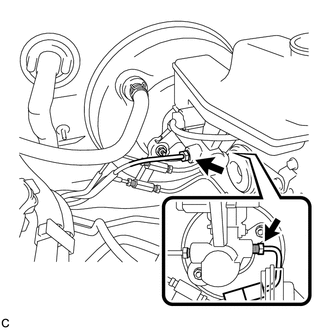
|
(b) Slowly depress the brake pedal and hold it down. |
|
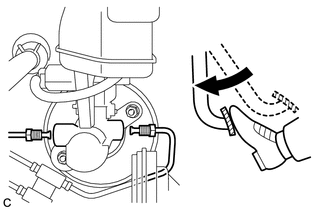
|
(c) Cover the 2 tube holes with your fingers and release the brake pedal. |
|
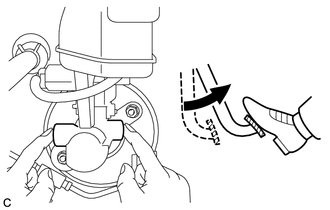
(d) Uncover the holes, slowly depress the brake pedal and hold it down. While holding down the brake pedal, cover the tube holes again. Repeat this step 3 or 4 times.
|
(e) Using a union nut wrench, connect the 2 brake tubes to the brake master cylinder assembly. Text in Illustration
Torque: Specified Tightening Torque : 20 N·m {199 kgf·cm, 14 ft·lbf} NOTICE:
HINT:
|
|
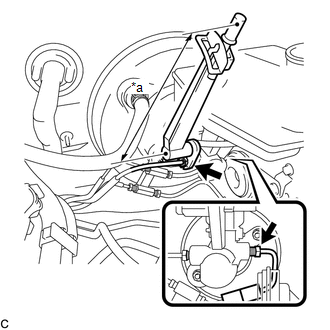
3. BLEED BRAKE LINE
4. INSPECT FOR BRAKE FLUID LEAK
5. INSPECT FLUID LEVEL IN RESERVOIR
6. CHECK AND CLEAR DTC
(See page )
 Replacement
REPLACEMENT
CAUTION / NOTICE / HINT
NOTICE:
Move the shift lever to P and apply the parking brake before bleeding
the brakes.
Add brake fluid to keep the level between the MIN and M ...
 Brake Line
Precaution
PRECAUTION
1. TROUBLESHOOTING PRECAUTION
NOTICE:
Since the brake lines are critical safety related parts, be sure to
disassemble and inspect the components if a brake flui ...
Other materials about Toyota Venza:
Removal
REMOVAL
CAUTION / NOTICE / HINT
NOTICE:
w/Camera mirror:The timing of the change between high beams and low beams differs
depending on the light transmission rate of the glass. For this reason, when replacing
the windshield, replace it with an original ...
A/C ECU Vehicle Information Reading/Writing Processor Malfunction (B15F5)
DESCRIPTION
This DTC is stored when items controlled by the air conditioning amplifier assembly
cannot be customized via the audio and visual system vehicle customization screen.
HINT:
The air conditioning amplifier assembly controls the air conditioning ...
Driver Side Power Window does not Operate with Power Window Master Switch
DESCRIPTION
When the engine is running or the ignition switch is ON, the power window regulator
motor assembly (for driver side) is operated by the power window regulator master
switch assembly. The power window regulator motor assembly (for driver side) ...

0.1278